Today’s Gospel reading centres on the parable of the talents, and it’s an especially puzzling one. It challenges us to think about what God’s will is for us. The parable in question is the one concerning the rich man who gives talents to three of his servants and then sets out on a journey, a long one. When he comes back he asks his three servants how they went with the talents. He finds out that the servant that he gave five talents to had invested them well and so did the servant that he gave two talents to. So these two servants managed to multiply the amounts that were assigned to them. And the master was very happy with these two servants. The third servant didn’t invest the talent he was entrusted with, he just buried the talent and hadn’t gained any benefit from it. So the master became angry, took the single talent from the timid servant and gave it to the servant who had invested well.
And then Jesus gives the surprising lesson : “For to all those who have, more will be given, and they will have an abundance; but from those who have nothing, even what they have will be taken away.”
Now the standard reading of this story is that the talents represent gifts and abilities that God has given to us, and that he expects us to use with generosity and wisdom. But even though the word “talent” as we use it today means a skill or a special ability, the word “talent” in this parable means something else. In the Biblical sense a talent means a specific weight, a talent corresponded to 34 kilos of gold. Not something that you can carry around in your pocket.
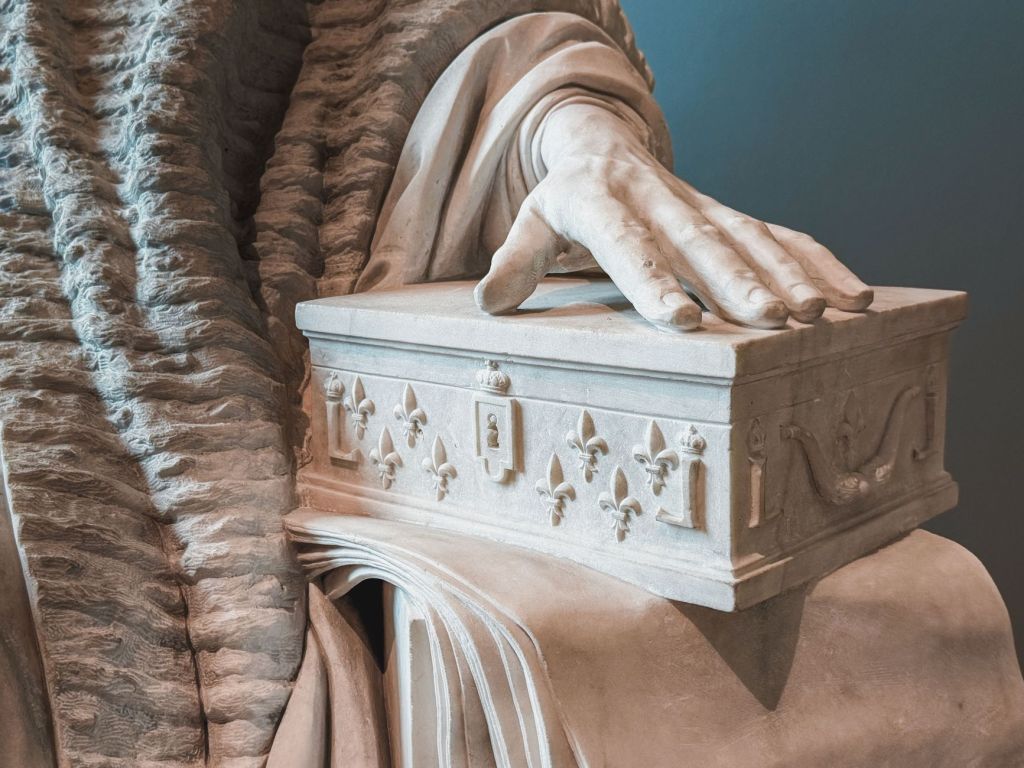
Now what a modern reader of the Gospel will most likely miss, but what an ancient Jewish reader would have caught right away, is the connection to heaviness; a talent was heavy, and five talents was really heavy. Heaviness would have brought to mind the heaviest weight of all, which was the kabod of Yahweh. The basic sense of the Hebrew word kabod is heaviness, or gravitas, and this word refers to the glory of God. The kabod was located in the Temple of Jerusalem and it rested on the mercy seat within the Holy of Holies. So the heaviest and most glorious of all things was the mercy of God, there in untold abundance in the holy temple.
Glory in this sense means something weightier than mere power or fame as we know it. The kabod of Yahweh conveys divine heaviness, glory and honour. The power and glory of God is talked about a lot in the Ark of the Covenant narratives. The Ark itself portrays the kabod of Yahweh. The Ark had the power to both bless and to curse. It was written that it destroyed the Philistines who had desecrated it, and it brought blessing to the house of the Levite Abinadab, where it stayed for 20 years.
In Revelation chapter 22 we read, “Then the angel showed me a river with the water of life, clear as crystal, flowing from the throne of God and of the Lamb.” This is another description of the kabod of Yahweh, of God’s abundance and outpouring of mercy. The water flows out onto the earth and makes things grow, it brings life wherever it flows. In the Ark of the Covenant stories, when God manifested himself to Moses on Mt Sinai, God didn’t just stay up the mountain there being awesome; God is always giving of himself. This is the heaviness, the weightiness of God, it cannot be held in, it needs to move to expand, it is like a dam bursting under the pressure of all that water. God doesn’t keep his power locked away. God’s love and mercy expands to fill the whole universe.
In light of this, we can look at the parable with the eyes of those who understood the deeper meaning of the talents.The talents are not so much monetary gifts or personal abilities, they are a share in the mercy of God, a participation in the weightiness of divine love. But we can see that mercy is something that is directed outwards, to others, and so these talents are meant to be shared. And they are multiplied in the same measure that they are given out. We receive divine mercy as a pure gift, and it is meant to be shared out to others as a pure gift too. If we bury it in the ground, if we hug it too tightly to ourselves, then it eventually disappears.
Just like the servants who were entrusted with the talents, we who receive the divine mercy, are expected to invest it, to spread it, and move it to others. In this way it can be returned to us and multiplied in an ever expanding process. The value of divine mercy lies in its capacity to be transferred. It’s like a railway carriage, its usefulness and productivity are manifested when the carriage is attached to an engine and it’s moving down the track. It’s no good to anyone when it’s parked at the station.
One of the first things I noticed about our little country town when we moved here, is that it’s such a giving and generous community. So many people volunteer. So many people have fruit trees or grow their own vegetables, and a lot of it is given away as a pure gift, there’s no need for anyone to go hungry. And this pure giving comes back to us in one form or another. I don’t think this is a naive concept. When people care for each other, it’s natural to give freely and happily, and it all comes from God. His kabod, his glorious mercy, is working in the world and through his people.That’s what happened with the miracle of the feeding of the five thousand. The just had a few loaves and fish, but everyone was fed. God’s power was working through the open giving hearts of his people, and of Jesus in particular, the fountain of all good.
As Christians, we express our feelings for God, we don’t bottle them up. Hoarding is not what being a follower of Christ is all about. Jesus was not in the business of keeping things to himself. Of course, sometimes he went off by himself to pray, sometimes I think that’s how he recharged his batteries, by reconnecting with the Father who sustained him. And then he came back and poured all that energy out to everyone he came into contact with, healing, loving, and caring. Jesus was, and is, all about the flow of love. He represents the outpouring of God’s mercy and glory.
Our God is an awesome God. These days, the word awesome is overused, I know I use it a lot for things that aren’t really awesome. I might say, “Oh wow, that’s great, you mowed the lawn, awesome!” Mowing the lawn is fine, but it’s not awesome. In any case, we’ve diluted this word quite a lot.
The word awesome means inspiring great admiration or wonder; something has to be a big deal to be awesome. The Ark of the Covenant wasn’t just a religious object, it represented the holy presence and glory of God; it was an awesome thing. So who or what should we be in awe of today? It’s Jesus. Jesus, who suffered so much and gave so much, and who fulfilled the will of the Father so perfectly. He changed the world, he changed us, he changed the course of history and brought our relationship to God to its fulfilment with diamond like clarity. Jesus gave us love without end. He said to us, “I will be with you always.” God’s awesomeness, his glory, the kabod of Yahweh, is personified in Jesus, a light that shines brighter than a thousand suns.
So what can we say about the servant who was given the one talent and who hid it? He was given this responsibility but he lacked the confidence to work with it, so he did the bare minimum, he kept it safe, it didn’t grow, it didn’t benefit anyone, it just sat there. He misunderstood what he was put in charge of. But the others had the confidence, the faith to take on this heavy duty responsibility, and they were successful.
You don’t just sit on a pile of divine mercy, glory and love, you let it out, spread it around, magnify it, make it even bigger and weightier. It doesn’t touch just you, it touches everyone who you touch.
So here we all are, saved through grace by faith in Christ.That’s the biggest blessing of all, and no one can take that away from us. We are saved, and God holds us in the palm of his hand. But it’s not enough to sit back and say, phew I’m saved, that was a close one, and just safely sit back and wait for the end of days.
While we are here, we are God’s servants, and his will is our will, in all things. Just like the master in the parable, God gives us special responsibilities to carry out and he hopes that we will do well, to accomplish what he wants. We are his hands and feet; God’s work has always been carried out through his people. We have been given the job of multiplying the weightiness of God’s mercy and glory. The parable tells us plainly that God is giving us something to not only safeguard, but to give out to others, just as he gives to us. God’s grace and mercy don’t just provide us with our own personal feelings of redemption and assurance, they are so much more, they are actual spiritual goods.
In the parable, the good, the talent, has a definable quantity, it’s 34 kilograms, you can measure it out, but in our lives God’s goodness is infinite, that’s where life differs from the parable. Analogies aren’t always exact. The challenging thing that Jesus tells us is that to those who already have a big measure of God’s goodness, more will be given, but to those who have little, even that will be taken away. On the face of it this may sound unfair. But it’s not. In reality, we all get an equal share of God’s goodness; he makes the rain to fall on the righteous and the unrighteous alike, there is always equity.
The issue lies in our awareness and understanding of God’s goodness. Do we recognise that all good things come from God? How do we perceive this generosity? Some people have been very blessed but they don’t see it, they don’t realise that God has been blessing them. To them it feels like what they have is never enough, they don’t see where their bounty comes from, and they end up feeling unfortunate, and dissatisfied. They will hoard what they have and keep it tightyly to themselves. Inevitably they will feel that what they have is dwindling, it’s being taken away. Nothing is ever sufficient for them. In the meantime, God doesn’t stop giving.
It is when God’s bounty is acknowledged and its value seen and understood, when it’s put to good use, and especially when it is shared with others that we feel the goodness and blessings of God. Eveything is a positive, and a gain, because that’s how we view it. God’s abundant giving is all around us when we see through the eyes of our love for God. And we receive so much more than what we give out. And what we have is sufficient. As the apostle Paul says in 2 Corinthians 3:5, “Not that we are sufficient in ourselves to claim anything as coming from us, but our sufficiency is from God.”
So God gives us the responsibility of dispensing his great mercy and love, and like the entrepreneurial servants, we have the confidence that our Lord Jesus gives us to take the great mercy bestowed on us, and to magnify his Glory. So what are the ways we do this? For some there’s charity, evangelism, and mission. God’s mercy is also shared in giving and forgiving, in fellowship, and in spending time to listen to a friend, in smiling when we don’t feel like smiling, in being a follower of our Lord in the way he showed us through his own life and example.
Christians who are giving of God’s great mercy, attract abundance, but not in material things.They are rich in the things of God: emotional well being, confidence, faith, hope, trust, and love in its broadest sense. They will always feel blessed. One of my favourite sayings is, “too blessed to be stressed.” It’s always good for the soul to be reminded of how blessed we really are.
Last Sunday we reflected on our own baptisms, we were asked to remember our baptism and be glad. We are made new in Christ and now God’s great power and love, his awesomeness, has been placed in our hands, to be used for his purposes. We are all the beneficiaries of this weightiness, the kabod of Yahweh. And we shouldn’t be afraid of this responsibility. Sometimes, the prospect of this responsibility can be scary. The might and majesty of God is sometimes described as inspiring fear. During the Transfiguration of Jesus, Peter, James, and John heard the voice of God coming out of the bright cloud, and they saw Christ’s divine glory unveiled. The fell facedown and were terrified.
The servant with the single talent was afraid of losing it. But risk is always part of the process, loss and disappointment happen. Putting yourself out there for God is risky, and there’s no guarantee of success. Imagine a missionary embarking with the weighty responsibility of dispensing God’s mercy and compassion, it could quite easily end in failure, and for some it did. That’s where confidence and faith are essential. But even if the worst happens, the master will say, “you gave it your best shot, you didn’t sit on your hands and do nothing, you put yourself out there for me, thank you good and faithful servant.”
In the parable the master said to the successful servants, “you have been trustworthy in a few things, I will put you in charge of many things; enter into the joy of your master.”
This is probably a slightly overlooked part of the parable. Here on earth we’re entrusted with a few things, in heaven, we’re entrusted with even more, we are given even more good. God opens up his arms and allows us into his divine joy. We enter into the joy of God. Let that sink in a little bit. The joy of God, what that must feel like. It’s a floodlight, it’s eternal happiness. It’s not just redemption, it’s not just salvation, it’s extra, it’s more than we can ever imagine. It’s not just the relief of being saved, it’s the whole box and dice, God’s supreme happiness, infinite, amazing, eternal. And it will be poured out to his good and faithful servants. How beautiful is this, and how awesome is our God, awesome in his benevolence, in his kindness, in his overwhelming graciousness.
I’d like to close the message with psalm 103:1
Bless the Lord, O my soul. Everything within me bless his holy name. Bless the Lord, O my soul and never forget all his goodness towards you.
Amen






Leave a Reply