
Homily for Palm Sunday
Palm Sunday always has an extra special significance for me, because our daughter was born early on a Palm Sunday. The day was fine and we saw the sun rising, the morning was crisp and cool, everything looked fresh and new, our first born was coming into the world. Personally, this day always stands for new life, new beginnings and of course, a whole lot of love. And Easter is a time during which we celebrate the greatest love of all, the love of our one true God.
Palm Sunday or Passion Sunday, marks the beginning of holy week, the most sacred and important time of the church year. We experience every emotion, a veritable roller coaster of feelings, as we draw closer to Easter: there’s joy, sorrow, jubilation, fear, anger, peace, everything… and these are the exact same feelings that Jesus our Lord went through as these critical days transpired. Holy Week is when we walk in his footsteps, we weep with him and we celebrate with him. And we’re not the only ones. Christians all over the world are walking with us, feeling these same emotions. From Canterbury to Rome, to Jerusalem, down into Africa, and across to China and India, and into the Americas; our brothers and sisters in Christ are all looking towards the day of days that commemorates what it means to have eternal life in Jesus our saviour.
This is the time that we feel the groundswell, just as Jesus did when he rode into Jerusalem. He would have been thinking… finally, it’s all happening. This is it.
Palm Sunday was the start of our Lord’s journey towards Calvary, and Jesus made sure that the prophecies about him would be fulfilled. The prophet Zechariah foretold Jesus’ triumphal entry into the city of Jerusalem, “Behold, your king comes to you; triumphant and victorious is he, humble and riding on a donkey, on a colt, the foal of a donkey.”
The importance of prophecy in scripture cannot be underestimated, everything had to be just right. Jesus sent his apostles into town to find the young donkey, that had never ridden before, in order to manifest this prophecy. Jesus here is incorporating himself, as the son of God, into the history of his people, within a strict prophetic tradition. The prophets were the voices of God on earth, they needed to be listened to, even though they were not valued or appreciated or honoured in their own lifetime. A graphic example of this attitude is the treatment that Jesus received in his own hometown of Nazareth. They even tried to kill him there by throwing him off a high place. All because he was telling them things they didn’t want to hear.
Zecharia spoke of a great king, and that was that the people were expecting and waiting for, so when Jesus entered Jerusalem on a donkey, that was like an underline. His teachings, his healings and the miracles, his mission for the previous three years demonstrated his power, and the fulfilling of Zechariah’s prophecy was the final heads up to the people. If they had any doubts before, these doubts were certainly gone by Palm Sunday.
We can only imagine how the people of Jerusalem felt, they were suffering under the Romans, paying taxes to a foreign, pagan power. Their own religious hierarchy had kept them poor by imposing the practice of sin offerings, the temple was bleeding the people dry. But now, finally, the Messiah was coming, the great king was on their very doorstep, promising an end to all that. He was going to give them freedom and political autonomy, prosperity and the forgiveness of sins. They didn’t have to pay money anymore to have their sins forgiven.
Imagine how happy everyone would be if someone today said to us, we’re getting rid of corrupt, war mongering political leaders and installing righteous, intelligent, godly leaders who will bring justice and mercy to the world. They would rule from a place of love and care and not hate and division. Finally, all people would live in peace. Wow, we’d all be out in the street leaping for joy! Now that would be something to shout about. I’m reminded of the old film footage of the people in London on VE day when peace was declared, and the unbridled joy of the massive crowds in the streets.
And that would have been the feeling in Jerusalem that day. The Messiah, the anointed one, had arrived to set them free. People knew that he was arriving. In the days before, as he was travelling from Galilee to the city, and right up to his arrival, Jesus had been casting out demons and working cures and healings. So the people were prepared for him. Many were following him into the city, and word had been sent ahead that he was coming. The people were thronging around him. Even religious leaders had come out to see what was going on, and they ordered Jesus to tell the crowd to stop the singing and praising. And then Jesus famously told them that if the people were silent, even the stones themselves would start to sing.
They were shouting “Hosanna,” waving palm branches and laying their cloaks on the ground in respect. The word Hosanna comes from a Biblical Hebrew phrase meaning “pray, save us.” They were calling to be rescued. Hosanna is not just a term of praise, it’s a prayer.
They expected a great earthly king, but little did they know that their expectations would come crashing down come the following Friday. I suppose that the people didn’t read the fine print, they just read the bit about Jesus the Messiah riding in triumphantly and coming to save them. However there was another prophecy. They didn’t realise that Jesus was also the suffering servant in the book of Isaiah. Hundreds of years before Christ was born, Isaiah prophesied about a Servant who would be rejected and despised, and bring salvation through His suffering. In a way the people had blinkers on. Most of them, possibly even his closest followers, didn’t put two and two together, Jesus was destined to suffer a humiliating death on the cross. They didn’t get what they expected, but the prophets, including John the Baptist, had told them that God would return on his own terms, with his own purpose.
When Jesus entered Jerusalem, he was representing the return of Israel’s God to his people, in power and glory as foretold in Zechariah. But Jesus knew that it was a different kind of power, a different kind of glory, but at the time this was incomprehensible. How could they know the mind of God? Isaiah also tells us: “For my thoughts are not your thoughts, neither are your ways my ways,” declares the Lord. The power and glory as understood by the people, was not the same power and glory that God had in mind for them, and us. God’s plans are often not our plans. Many, many times, God doesn’t give us what we want, he gives us what we need.
As holy week continued it soon became clear that the people’s notion of salvation was not going to be fulfilled. There was not going to be a political liberation. God’s plan of salvation was going to be an altogether different matter. Angered and frustrated by this turn of events, the crowds later turned on Jesus and abandoned him, giving him up to be crucified.
Hosanna, Save us, the people cried. Salvation is the fundamental theme of Holy Week. Jesus comes to save us, as individuals and also as a group, as the body of his believers.
What is the salvation that Jesus promised by his peaceful and non-violent, victory? It’s not salvation from political oppression, or even religious persecution. We can see examples of the oppression of people of faith continuing today. What we are being freed from is the tyranny of death and the shackles of the self. Salvation is not going to make our lives easier here on earth, but it does give us immense freedom, and joy, and the peace that comes from knowing that God holds us in the palm of his hand and that this bond is unshakeable. Salvation is the open door to the kingdom where Jesus reigns.
Some people think of salvation as God cleaning our slate and giving us a second chance and offering forgiveness, but there’s more to salvation than just being forgiven. We are being saved from something, but we are aslo being saved to someone, and that person is God. In spite of our brokenness, we have been given the freedom to go to God through the gate that is his blessed Son, our Lord Jesus Christ. We are saved for a relationship.
The New Testament clearly asserts, and Christians have always believed in what Paul says in 2 Corinthians, “God was in Christ, reconciling the world unto himself.” I’d just like to read some words from Cannon Michael Green, and he says, “no mere man, no third party, no angel, but God himself was present in a unique way in the person and the sufferings of Jesus on Calvary. That is what makes the cross so pivotal, the identity of the sufferer. There never has been and there never will be a parallel to that. The very name Jesus means Yahweh saves.”
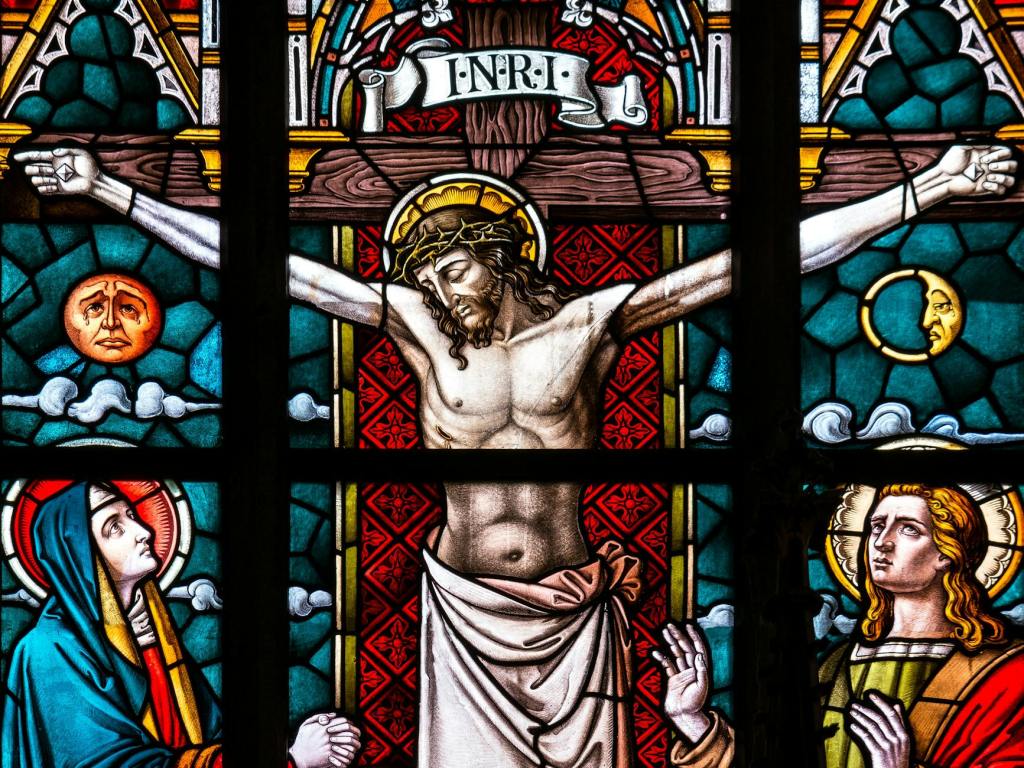
Salvation means that God has removed our greatest obstacles so that we can be brought into a communion with him. This is our greatest good, and when Jesus gave himself up on Good Friday, he rescued each and every one of us. In that one great, awesome moment, all the barriers to God were taken down and smashed to bits, and the power of sin and death was broken. But this wasn’t the end of it. On the third day Jesus was raised up in glory, and because he lives, we live. And this is why we rejoice and shout Hosanna to our king, for we have been saved, in the only way that really counts.
Amen



 Tell Out My Soul
Leave a comment