
John 18:33-37
Today we celebrate the feast of Christ the king, but often during this holy day Jesus is portrayed not with a golden crown but with a crown of thorns, his true crown, the symbol of his heavenly kingdom. He is the king of love on Calvary, and he came to us to bear witness to the truth.
I remember when I heard the news that Queen Elizabeth had passed away, it felt slightly unreal. She’d always been there in my life. I suppose I always took it for granted. Australia is part of the Commonwealth so historically we’re a monarchy, but I never really gave it a lot of thought. And it feels a little strange having King Charles now, I suppose it’s something that we’ll get used to. I haven’t seen his head on a coin yet, but I figure that when I do, it’s going to seem a little weird. We’re seriously a monarchy. Obviously the monarchy these days is symbolic more than anything, political power is held by the people via the parliament. It’s not the same as having one person on a throne, ruling everything.
Once upon a time, the king was a political leader and, also very importantly, a protector. Way, way back, the Israelites had a high priest, but no king, no army, nothing like that. They got together and went to Samuel and demanded to have a king, mainly because, as a people, they felt vulnerable, they had enemies on all sides. They wanted a powerful leader who could protect them from their enemies, in real physical ways, someone who would fight for them. Something that a priest was unable to do.
The image of a powerful individual such as a king instills confidence. Would a person feel more protected by a bunch of public servants or by a person, with a crown and sceptre, who’s wise, brave and loyal, who can make things happen without having to go to a committee? Once upon a time a king’s power was absolute. I’m not saying that this is always a good thing, and we don’t have to look far to see examples of tragic abuses of power, for example, the reign of Henry the VIII. As the saying goes, power corrupts and absolute power corrupts absolutely. And unfortunately in the end, the Israelites first king, king Saul, was a bit of a failure. But as we heard in the reading from 2Samuel 23:1-7, the king who rules over people justly, ruling in the fear of God, is like the light of morning.
Jesus is our true and perfect king, perfectly loving, caring and protecting. He fights for us, and he wins. In his dying and rising, Jesus conquered sin and death.
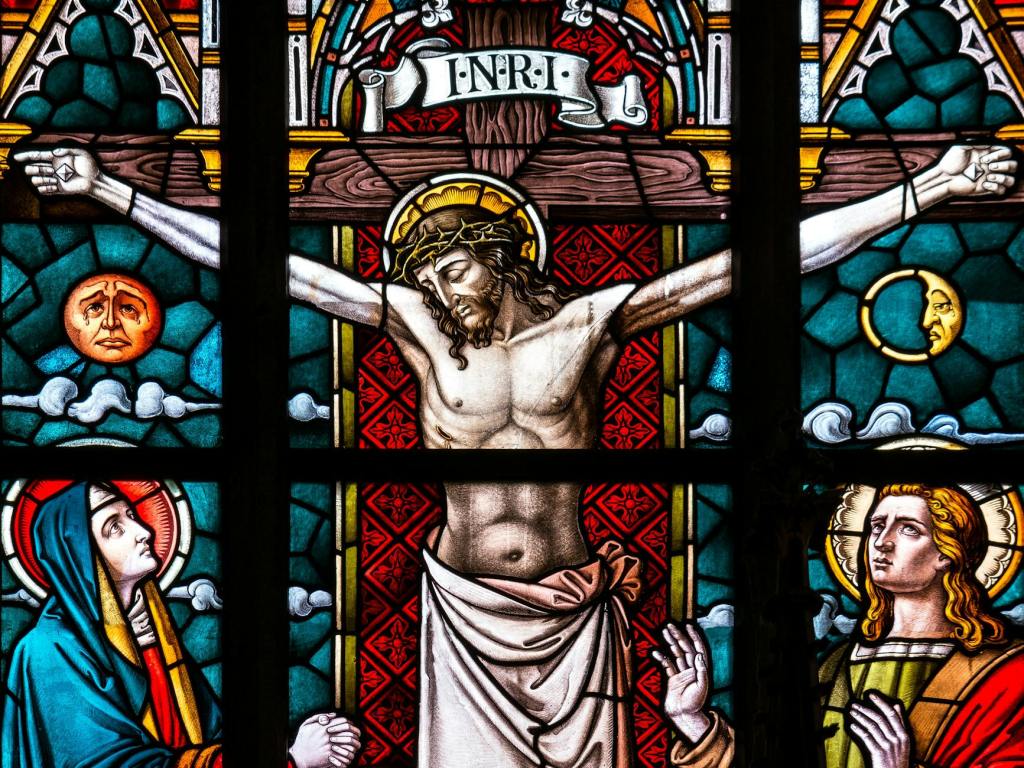
When Jesus was crucified, the charges against him that were nailed to the cross were “Jesus of Nazareth, king of the Jews.” He was descended from the line of David and he had huge popular support among the Jewish people, so the authorities believed that this was the role that he had taken on, the role of a Jewish king, here on earth, and that his motives were political. In reality, this wasn’t the case because Jesus did not choose to be an earthly king, as much as many of his followers wanted him to be.
When Jesus was brought before Pontius Pilate, Pilate asked Jesus, “are you king of the Jews?” But Jesus evaded the question, he told Pilate that his kingdom was not from this world. Jesus didn’t see his kingship as an issue and he glossed over the question. Instead he told Pilate directly what his mission was. He said:
‘For this I was born, and for this I came into the world, to testify to the truth. Everyone who belongs to the truth listens to my voice.’
This is just so important, in Jesus’ own words, he tells us why he came to us. “For this I was born”… these are words that make us sit up and listen, it’s like the last page of a really good who dunnit, this is the phrase that reveals the mystery.
Jesus talks to us about people belonging to the truth, as though truth itself is something that can own us, and indeed it does. Jesus tells us, I am the way, the truth and the life. He is truth itself, its personification and embodiment. Therefore when he says that people who listen to his voice belong to the truth, he’s actually saying that the people who listen to his voice belong to him. The person of Jesus, everything about him, the reality of his life with us and his eternal life with the Father, embodies this truth. I am the truth, he said.
Before Jesus, God’s truth was contained in the Law that was given to Moses, and the people belonged to the Law. Jesus came to fulfill this Law, in effect to write the next chapter, and to be the next chapter.
I’m reminded of Jesus talking about the sheep and the shepherd in John chapter 10:
And the sheep listen to the voice of the shepherd. He calls his own sheep by name and leads them out. When he brings all his sheep out, he goes ahead of them, and they follow him because they know his voice. But they will never follow a stranger.
We belong to the truth because we listen to Jesus’ voice. And what a good feeling it is to feel that we belong. And belonging to Jesus, well, I don’t think it gets any better than that.
Pontius Pilate also asked Jesus “What is truth?” It’s a throw away line. From Pilate’s position of power, truth is optional, inconsequential even; truth can be defined anyway one wants to. It was pointless for Jesus to try to explain things to him. Pilate was all about rules and regulations, and the power of Rome. That was his truth. In the rock opera Jesus Christ Superstar, which interprets the Gospel of John, Pilate tells Jesus, “we all have truths, are mine the same as yours?”
So often the truth is extremely subjective. Studies have shown that the brain takes shortcuts when conveying information from the eyes to the brain. That’s why different witnesses to the same accident will sometimes give very different reports of what actually happened and what they saw. But all of them will swear that what they saw was true. And we’ve all seen those optical illusions that are designed to show two different realities at the same time.
Like the picture of the white vase against a black background that if you look at it differently appears to be two profiles in black looking at each other against a white background, both images are true.
Some truths on the other hand are self evident eg one plus one is two. Maths is a very truthful thing. There’s only one right answer. So some things can be absolutely true, but in the world of known things, a great deal of them are, unprovable, and just well, points of view. What is true for one person is not true for another person. Truth can be elusive and very, very fuzzy. And of course there are downright lies. Both Jesus and Pilate were aware of this.
Facts can be manipulated, twisted and confused. Jesus was trying to avoid this at all costs, and his mission depended on his followers knowing the real truth about him, and God, and sticking to it. At the time of Christ, the Jews were living in a very precarious age, they were ruled by a tyrannical foreign power, they wanted a king to lead them out of all the terror and the danger, a king to protect them. They wanted a leader who was going to give the Romans a taste of their own medicine. They wanted someone to remove their fear and return them to their former glory. And they got a king who did just that but not in the way they expected.
Jesus was a different kind of king, one that would give them a defence that was even more powerful than military might… and that protection was divine truth. Jesus gave them a truth so powerful, so reliable and so unchangeable, that it could sustain people no matter what. God’s truth withstands all contradictions, and all conditions. It stands up against all attack. Here the word unassailable is so appropriate, the truth that Jesus is witness to is unassailable.
Jesus came into the world to show and tell humankind that God’s truth is reality and that God’s truth is eternal. Earthly kingdoms come and go, and earthly monarchs live and pass away, but our heavenly king rules forever.
In this technological age, it’s getting harder and harder to tell the difference between what’s real and what isn’t. Now we have artificial intelligence generating false images, deep fakes, misinformation, all spreading out over the internet at an alarming rate. It’s even reached the total absurdity of the flat earth theory… again. The ancient Greeks worked out that the Earth was a sphere in the third century BC when a mathematician called Eratosthenes calculated the circumference of the earth with an error margin of just 1%. Good old mathematics. It just makes you shake your head in wonder, that some people can be so deceived about something as fundamental as the shape of the earth. But there you are.
But the truth today is being assailed on so many levels. Every day we’re bombarded with advertising. Most of the time it’s just a series of lies and misinformation, or empty promises. There’s information from people who claim to be experts but who aren’t. But apart from that, the most worrying thing is the fabrication and deceit practiced by so many people in power, just to get what they want. Who or what are we supposed to believe?
Sometimes we just need to cut through the deception. I read a recent Facebook post saying something along the lines that, there is no archaelogical evidence that Moses existed or that the Exodus happened. And the only historical written references to Moses occur in the Bible and the Torah. Well, that’s right. But then it went on to say that Moses, and the Exodus from Egypt was possibly all just a myth, and we can’t say it’s true because it’s not backed up by physical evidence. But then I looked at the comments, and another person responded to this post saying, by saying that, well of course Moses was real and the Exodus happened… and this was what I found compelling… he said Moses was real because Jesus talked about Moses.
This person cut away all the peripherals of this argument and stated categorically that, if Jesus said so then it was true, end of story. To this person, it didn’t matter that archaelogists haven’t yet found physical evidence of Moses. Moses existed because Jesus tells us so. He didn’t need any other authority, no other witness to the truth other than our Lord. And then I thought, wow, this really is an example of someone listening to Jesus’ voice.
Pilate asked, what is truth? And a useful approach to actually answering this question is to look at what truth is not. Truth is not lies, misdirection or deceit, it’s not gas lighting or double dealing. Jesus does none of these things. Lies and deceit are used to gain advantage and benefit for one person at the expense of others. In a lie, someone gains and another suffers. Jesus is the opposite, he is incapable of lies or dishonesty. He is the one who unconditionally gives without counting the cost. He died so that we might live, and live life completely. This is what he was born to do.
Jesus is truth, and when we belong to him, we belong to the truth. Belonging to him means that we, as the body of Christ, become a part of this great reality. We who listen to Jesus’ voice embody and express the truth that he came to earth for, that he lived and that he died for, and that he rose from the tomb to show us, in all its glory. Belonging to him means that Jesus takes ownership of us; he’s the shepherd whose voice we listen to and follow, and the Lord who we serve every day of our lives.
Everything he has said and done is real and unassailably true, without question. What blessed liberation this gives us, to be able to rest in this knowledge, to be free of doubt and uncertainty, and to know that we’re loved, protected and cared for forever by our heavenly king. Amen.




 Tell Out My Soul
Leave a comment