
John 12:20-33
In this morning’s message I’d like to talk about our reading from the gospel of John that we’ve just listened to, and share with you some thoughts on the theme of “wanting to see Jesus.”
So, in this situation, Jesus had left Bethany where he had been staying with Lazarus, Mary and Martha, and he was on his way to Jerusalem for the Passover. Crowds followed him including people who’d witnessed Jesus raising Lazarus from the dead, and they were telling everyone about it. His acclaim and his celebrity was spreading rapidly.
Then some Greeks appeared on the scene, now these men were not gentiles, but Hellenised Jews, part of the Jewish diaspora at the time, and they were also on their way to Jerusalem to join in the Passover. They approached Phillip and made an extraordinary request, “Sir, we wish to see Jesus.” These men were foreigners, and they wanted see for themselves who this person was that they’d heard about.
They too had found out about this incredible thing that Jesus had done, he’d raised a man from the dead. Naturally, they tried to seek him out and wanted to meet Jesus face to face. They wanted to connect personally with this worker of miracles.
We can see this was a very unusual encounter for Philip, this sort of thing didn’t happen every day. Philip didn’t say “oh yeah sure come this way, have a seat, he’ll be with you in a minute.” He didn’t know what to do, so he went to Andrew and told him. I can just imagine the scene, the two disciples are talking to each other, “Well what do we do with these Greek guys, man I don’t know, I can barely understand a word they’re saying. Let’s see what Jesus has to say.” So, the both of them went to Jesus. And as soon as they told him about the Greek seekers, Jesus realised that this was a pivotal moment. This event was the trigger for the discourse that followed.
Jesus went into a very heavy discussion about his death, and about eternal life, and while he was talking even God’s voice was heard speaking to them. I’m sure that Phillip and Andrew weren’t expecting anything like this. Jesus said, “The hour has come for the Son of Man to be glorified.”
There were several occasions in which Jesus spoke about “the hour.” Timing during his ministry was important. When Mary his mother asked him to help out at the wedding in Cana because the host had run out of wine, Jesus said “Woman, what does this have to do with me? My hour has not yet come.” His mother said to the servants, “Do whatever he tells you.” That was such a typically mum thing to do, it makes me smile every time I read it. There was a set time for him to be glorified, and the miracle of turning water into wine was right at the start of his ministry. He didn’t especially want to do a miracle that soon, but of course what Mum says goes, and so he did what Mary asked him to do.
The fact that the Greeks had arrived wanting to see him meant that his appointment with destiny had come.
He realised that his mission was finished, in effect, his message, his actions, the miracles ,were going to go, as they say these days, viral. The good news of salvation was on the threshold of going beyond Gallilee and Judea, it was going out to the world, his teachings would become cross cultural. Jesus was no longer just a preacher or prophet or rabbi, he was soon to be perceived as the Messiah, the saviour god. There was no more for him to do at that point.
The next stop was going to be Calvary. He knew that he wasn’t going to see his family and friends anymore, and that this was going to be the last Passover he would share with his disciples. He was going to face pain, darkness and death. Nothing was ever going to be the same again, indeed, the world was never going to be the same.
Let’s put ourselves in Jesus’ shoes. Everything has led up to this point, the last three years, full of hopes and fears and emotional investment… so much is wrapped up in this singularity, all this anticipation. And then it arrives; there’s no going back and in many ways the situation is totally out of your control. There’s an incredible groundswell, a feeling that you’re being pushed along against your will. Naturally there’s resistance and a kind of panic… but you realise that your will doesn’t matter anymore. Sheer faith takes over, faith that your life is in God’s hands no matter what and that it’s God’s will that is important; you’re throwing yourself into the arms of God.
Jesus expressed all these feelings when he said, “Now my soul is troubled, and what shall I say? ‘Father, save me from this hour’? No, it was for this very reason I came to this hour. Father, glorify your name!”
The seeking Greeks wished to see Jesus, but we’re not told whether they actually got to see him. John talks about the ability to see something that is not accessible to ordinary sight. It’s not necessary to see in the literal sense in order to believe. Here we can think of Jesus’ words to Thomas, “Blessed are those who have not seen and yet have come to believe”.
The gospel of John is all about the big picture, the great mystery. Right from the start, it’s enigmatic, “In the beginning was the word: the word was with God and the word was God.” John’s gospel has universal themes and it’s a ringside seat to the Godhead. Who was John? He was the disciple that Jesus loved. Together with James his brother, and Peter, he was part of the inner circle, he more than anyone would be able to understand at a fundamental level, Jesus’ role, his motives, his identity as the son of God. John saw the big picture. He was an uneducated fisherman, but he “got” Jesus, he was on the same wavelength of his Lord and friend. They were very close friends. Best friends. He was, to use a popular phrase, a brother from another mother. John stuck by Jesus through thick and thin, it was he who went with Jesus into the house of Annas the high priest when Jesus was arrested.
He was the only apostle at the crucifixion, the others, frightened and in hiding, weren’t there. But John stayed, this was so brave of him. It’s very probable that Jesus had at least two younger brothers, but when he was dying on the cross, it was to John that he gave the responsibility of taking care of Mary his mother, and likewise he instructed Mary to regard John as her son.
And we are so lucky to be able to have the benefit of John’s deep affinity, closeness and understanding of our Lord, which he so eloquently demonstrates in his amazing gospel. Because John was so close to Jesus, this gospel is dear to my heart. I always have a copy of John nearby because when I read his words, I feel close to Jesus too.
The whole of John’s Gospel hinges on a call to belief. John totally believes because of his deep understanding and fellowship with Jesus, and he wants, most fervently and with great love, to make others believe just as he does. Perhaps the Greeks in search of Jesus, and wanting so earnestly to see him, represent those of us for whom this gospel is written.
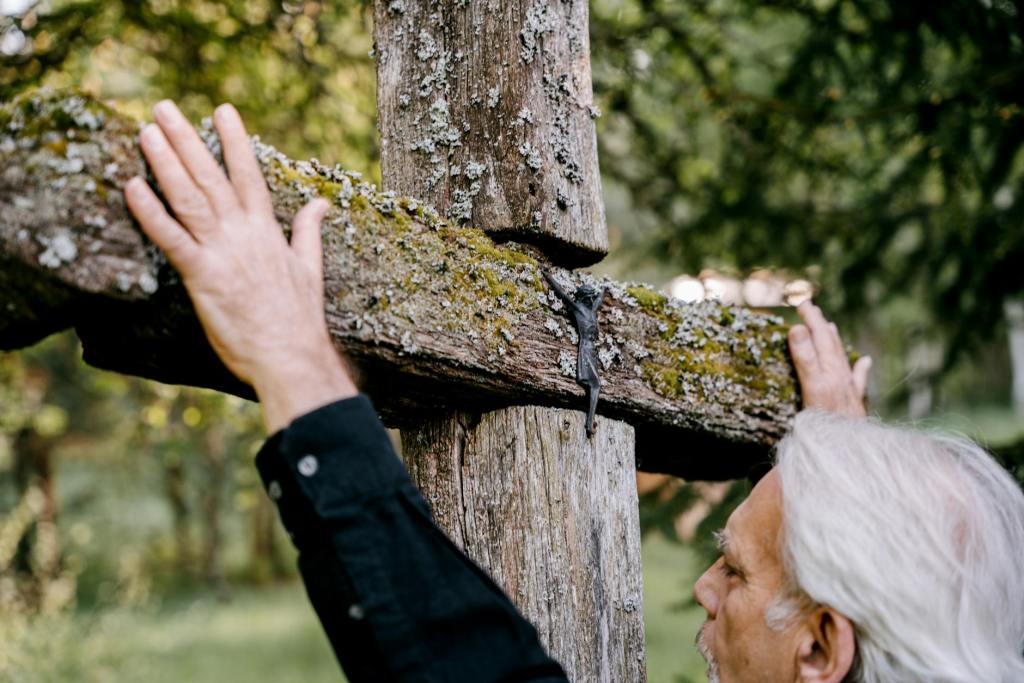
Today, the ultimate vehicle through which all people can see God is the cross of Jesus. The cross became a universal symbol that would change everything. We have a God who is willing to share in our pain, in our human experience. There is no other in history who has done this. For sure, there are many paths to the realisation of the godhead, but in this time and place, as Christians, we have been invited to join ourselves to a personal God, who laid down his life so that we may have life eternal in Him. No one before or after has offered us this kind of grace. Through Jesus’ act of supreme love, we have been allowed to enter into a place where we see God and know God fully.
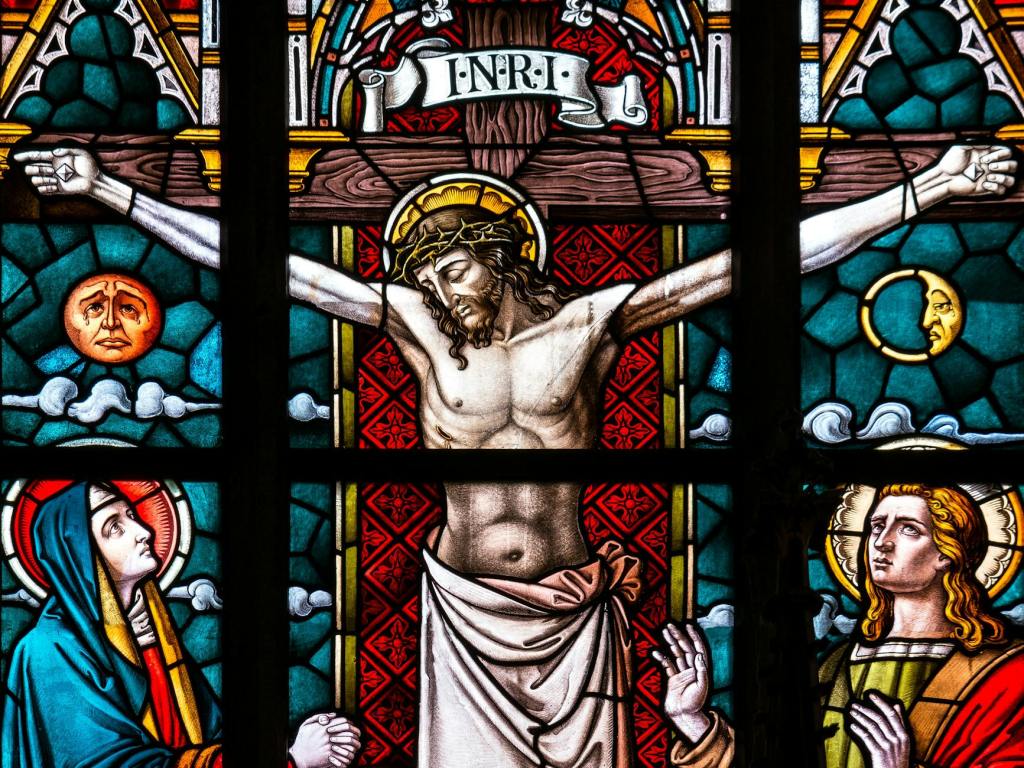
When I was a child going to church, there was a large cross to the side of the main altar and on it was a pure white, life size marble sculpture of Jesus crucified, his head and body marked with the wounds of his torture and death. It focused our attention on his sacrifice, his suffering. But this is not the whole picture. There are two aspects to the cross of Jesus. There is another type of cross and that is the empty cross that we see here, in its central position. The empty cross is the symbol of Christ resurrected. The body is no longer there, it has been raised up by God. Jesus suffered and died, and was raised on the third day, sealing the covenant that would ensure eternal life for all who follow him.
Jesus came to the final act of his mission of salvation and what he was saying to us was this: “come, everyone, all my children around the world, and the ones that are yet to be born, see me, I came for you. Open your eyes, and look upon your God, who is at once your brother, your friend, your saviour.”
We’re lucky, we don’t have to go hunting high and low for Jesus. We don’t need a personal interview like the Greeks in this reading. When we read John’s gospel, we can hear Jesus, and when we look up at the cross, we can see Jesus.
Jesus said, “Now is the time for judgment on this world; now the prince of this world will be driven out. And I, when I am lifted up from the earth, will draw all people to myself.”
When Jesus was crucified and raised up again, when he made the ultimate sacrifice, evil had no answer. He swept away the shield of ignorance so that all people could see him for who he truly was. And we too, living in the 21st century can all see Jesus for who he truly is, our Lord and our God.
As we approach the end of Lent, we can feel the groundswell too, the inevitable movement towards Calvary and onwards to the glory of the empty tomb. There’s not much time left before Easter. This is the quiet time, when things slow down and we look into ourselves and see how we truly are, and how we can make ourselves better. We take the opportunity to reconcile ourselves to our God. And we also look outside ourselves, to the cross, what it means to each of us on a personal level, and also, what the cross means to us as members of the body of Christ.
May we always long to see you Lord.
Amen




 Tell Out My Soul
Leave a comment